Common Cavapoo Behavior Problems and the Instinct Behind Each
General training information. Every dog is an individual; for health or behavior concerns, see your veterinarian.
Most Cavapoo behavior problems are not signs of a bad dog. They are normal dog needs that went unmet or got rewarded by accident. This guide walks through the most common Cavapoo problems, explains the instinct likely behind each one, and gives you a plan you can start this week.
The Cavapoo is a cross between a Cavalier King Charles Spaniel and a Poodle, usually a Toy or Miniature Poodle. Petful describes the breed as highly trainable, and Healthy Paws Pet Insurance says it responds well to positive reinforcement. That is good news. It also means the dog learns your accidental habits quickly.
Why a Cavapoo acts the way it does
Healthy Paws says the cross was built to combine the Poodle's intelligence and low-shedding coat with the Cavalier's gentle companion temperament. Purina Australia describes the Cavoodle (the Australian name for the same cross) as friendly, affectionate, sociable and playful.
Put those pieces together and you get a dog designed around people. Most of the problems below grow from that. A dog bred for company struggles when it is alone. A smart dog invents its own jobs when bored. Individual dogs vary, so treat these patterns as starting points, not predictions.
Materials you will need
- A crate or a small, puppy-proofed pen with a comfortable bed
- Small, soft treats that you can break into pea-sized pieces
- A measured portion of your dog's regular food, so treats can come out of the daily meals
- Two or three safe chew toys and a food puzzle or lick mat
- A flat collar or harness and a 4 to 6 foot leash
- A slicker brush and a metal comb for coat care
- Enzymatic cleaner for accidents
- A notebook or phone notes to log when problems happen
- Ten minutes, two or three times a day, for short sessions
Everything here is reward-based, in line with the American Veterinary Society of Animal Behavior (AVSAB). Skip shock, prong or choke collars, alpha rolls, scruffing and any dominance-style correction. They add fear to a problem that is usually about need.
Step 1: Start with the basics before fixing any single problem
Many Cavapoo problems shrink when the dog's basic needs are met. Greencross Vets suggests about 30 to 60 minutes of daily exercise for the Cavoodle. Petful describes two short-to-medium walks plus play. Neither source calls for intense exercise, and Greencross notes that an understimulated dog may chew.
Add mental work to the walks. Scatter feeding, a sniffing walk, and short training games tire a smart dog out in ways a fast lap does not.
For puppies, Petful notes adult size arrives around 9 to 12 months. Keep play short and frequent, with rest in between, and avoid forced running or long hikes on developing joints.
If you want the full foundation of cues and routines, the complete Cavapoo training guide covers them in order. The steps below build on it.
Step 2: Separation distress
What it looks like: Petful lists separation anxiety as a known challenge for the breed, with barking, chewing and house-soiling when the dog is left alone. Some dogs also pace, drool or follow you from room to room.
The instinct behind it: This is a companion breed. The Cavalier side was bred as a lap dog, and the cross was built for closeness. Being alone is not a normal state for a dog like this unless you teach it to feel safe that way.
Prevention and training plan:
- Teach a bed or crate as a happy place. Feed meals there and drop treats in while the dog is relaxed.
- Practice tiny absences. Step out of sight for two seconds, return calmly, and reward quiet behavior. Build to a few seconds, then a minute, then several minutes.
- Keep departures and arrivals boring. No big goodbyes, no excited greetings. Wait until the dog is calm before you interact.
- Give a long-lasting chew or lick mat right before you leave, and pick it up when you return.
- Increase time alone only when the dog stays relaxed. If the dog panics, you moved too fast. Go back a step.
Common mistake: Leaving for hours too early in training. Each panic episode can undo the progress you made.
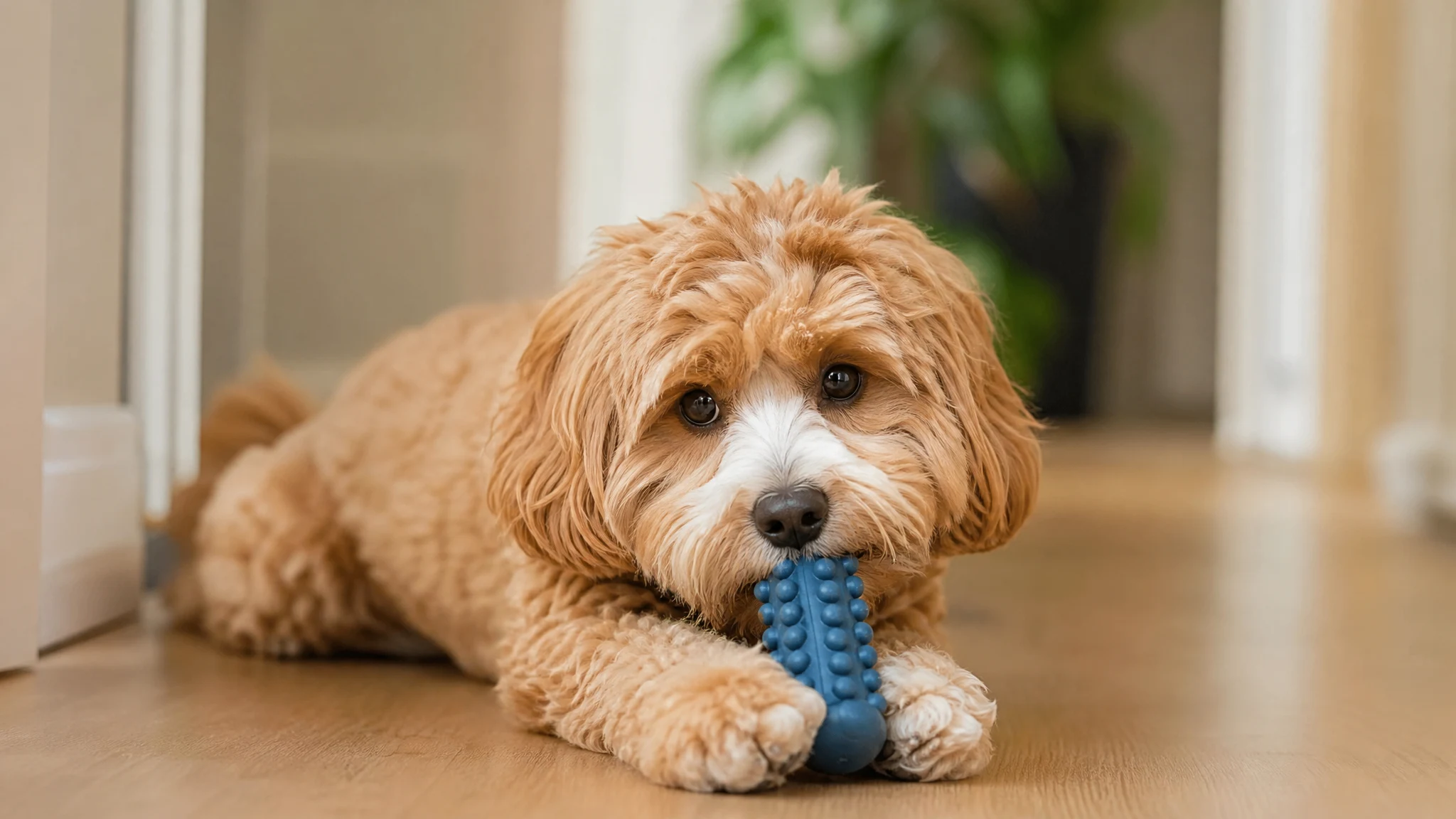
Step 3: Destructive chewing
What it looks like: Shoes, table legs, remote controls, and corners of furniture.
The instinct behind it: Chewing is how dogs explore, relieve teething discomfort and burn off energy. Greencross says an understimulated Cavoodle may chew, and Petful links chewing to being left alone. In a smart breed, boredom and stress are the likely drivers.
Prevention and training plan:
- Manage the space. Keep tempting items out of reach and use a pen or gate when you cannot watch.
- Offer approved chews often. When the dog picks up a toy on its own, quietly praise or treat.
- If the dog grabs a forbidden item, trade. Show a treat, let the item drop, and hand over a toy.
- Review exercise and mental work from Step 1. A tired, satisfied dog chews less.
- Rotate toys weekly so they stay interesting.
Common mistake: Chasing the dog around the room. Chase turns your shoe into a game. Trade instead.
Step 4: Barking
What it looks like: Barking at the door, at noises, or when you are out of sight.
The instinct behind it: Healthy Paws rates the breed's barking as low, and says it is not likely to bark much even at strangers. Greencross says Cavoodles can be alert watchdogs that bark at strangers. So individuals differ. When a normally quiet dog barks a lot, look at the cause: alerting, attention-seeking, or distress when alone.
Prevention and training plan:
- Log when barking happens for three days. The pattern points to the trigger.
- For alert barking, thank the dog once, then call it to you and reward for coming. Do not shout, which can sound like barking along.
- For attention barking, wait for one second of quiet, then reward. Slowly stretch the quiet time.
- For barking only when you leave, treat it as separation distress and return to Step 2.
- Teach an alternative behavior, such as going to a mat when the doorbell rings.
Common mistake: Giving attention, even scolding, in the moment of barking. Dogs often count any attention as a reward.
Step 5: House-soiling
What it looks like: Accidents indoors, sometimes only when you are away.
The instinct behind it: Young puppies simply lack bladder control and need a routine. Petful lists house-soiling among the signs of separation distress, so accidents that happen only when the dog is alone may be stress related. Because sudden changes in toileting can have medical causes, ask a veterinarian first.
Prevention and training plan:
- Take the dog out after waking, after meals, after play and before bed.
- Go to the same spot and reward right after the dog finishes, not when it comes back inside.
- Supervise indoors. When you cannot, use the crate or pen for short periods.
- Clean accidents with an enzymatic cleaner so the smell does not draw the dog back.
- Never punish an accident. The dog learns to hide, not to wait.
Common mistake: Expecting a young puppy to hold it for hours. Keep the schedule frequent and adjust as the dog grows.
Step 6: Resisting grooming and handling
What it looks like: Wriggling, mouthing the brush, or running away at brush time.
The instinct behind it: Dogs do not naturally enjoy being held still and combed. It matters because Petful says the coat mats easily and needs frequent brushing. Healthy Paws also says coat varies by individual, so some dogs need more work than others. Matted fur tugs and hurts, which makes the dog even less willing next time.
Prevention and training plan:
- Start with touch only. Touch a paw, ear or tail base, then treat.
- Show the brush, let the dog sniff it, and treat. Then one gentle stroke, and treat.
- Build to a few strokes per session. Work in small sections, and use the comb to check for tangles near the skin.
- Brush often, in short sessions, rather than rarely in long ones.
- End on something the dog likes, such as a chew or a short game.
Common mistake: Waiting until the coat is matted. If mats are tight to the skin, ask a professional groomer for help rather than pulling.
Step 7: Begging and treat-related weight gain
What it looks like: Staring at you while you eat, pushing for treats, and a rounder waistline.
The instinct behind it: Food works as a reward for any dog, and an eager-to-please Cavapoo will happily work for it. Petful lists weight gain from treats as a challenge for the breed. Because treats are your main training tool, it is easy to overdo them.
Prevention and training plan:
- Measure the daily food and set aside part of it for training.
- Use pea-sized treats, and mix in praise, play and toys as rewards.
- Teach a settle on a mat during your meals, and reward the dog there.
- Make sure everyone in the house follows the same rule. One person feeding from the table undoes the rest.
- Ask your veterinarian what a healthy weight looks like for your individual dog. Healthy Paws gives a wide adult range of 9 to 25 pounds, depending on the Poodle parent, so a single number is not enough.
Common mistake: Counting treats as free. Small bits add up.
Tips for success across all problems
- Socialize early. Elanco recommends early socialization, and the breed is generally sociable with other pets. Pair new people, dogs and places with treats.
- Supervise small children. Healthy Paws says the breed is generally good with children, but very small children should be supervised.
- Keep sessions short. Five to ten minutes, ending on a success.
- Be consistent. Healthy Paws notes the breed responds to repetition and routine, and that patience helps.
- Choose your breeder carefully. Petful notes there is no breed standard, so quality varies by breeder. Elanco advises screening both parents for inheritable conditions. Ask to see the health testing in writing.
Common mistakes to avoid
- Punishing the dog after the fact. It does not connect the correction to the earlier act.
- Using fear or force. Those methods go against AVSAB guidance and can make anxiety worse.
- Skipping exercise and mental work, then expecting calm behavior.
- Moving too fast on alone-time training.
- Treating a sudden behavior change as a training problem when it might be medical.
What results to expect
With steady practice, many owners see problems like chewing, begging and grooming resistance ease over several weeks. Separation distress often takes longer and may need months of gradual work. Progress is rarely a straight line, and bad days are normal.
No plan can promise a specific outcome, because each dog's age, history and temperament differ. If you see steady improvement, you are on the right track.
When to call a veterinarian, certified trainer or veterinary behaviorist
Start with your veterinarian if a behavior appears suddenly, if toileting changes, or if your dog seems to be in pain or acts differently than usual. Behavior and health are closely tied, and I cannot diagnose a dog or advise on medication.
Petful and others list conditions that affect the breed, including mitral valve disease and syringomyelia from the Cavalier side, and patellar luxation. A vet can check for medical causes before you assume it is training.
Call a certified professional dog trainer who uses reward-based methods if you have followed the plan for a few weeks and are not seeing progress, or if you want help with timing and handling.
Ask for a veterinary behaviorist if any of these apply:
- Your dog panics when alone, injures itself, or damages doors or crates trying to escape.
- Your dog growls, snaps or bites.
- Anxiety is affecting your dog's eating, sleeping or daily life.
- Training has stalled and you suspect a medical cause.
Medication decisions belong only to a veterinarian. A good trainer or behaviorist will welcome a vet's input, and will use rewards, not force.