How to Train a Cavapoo: The Complete Guide
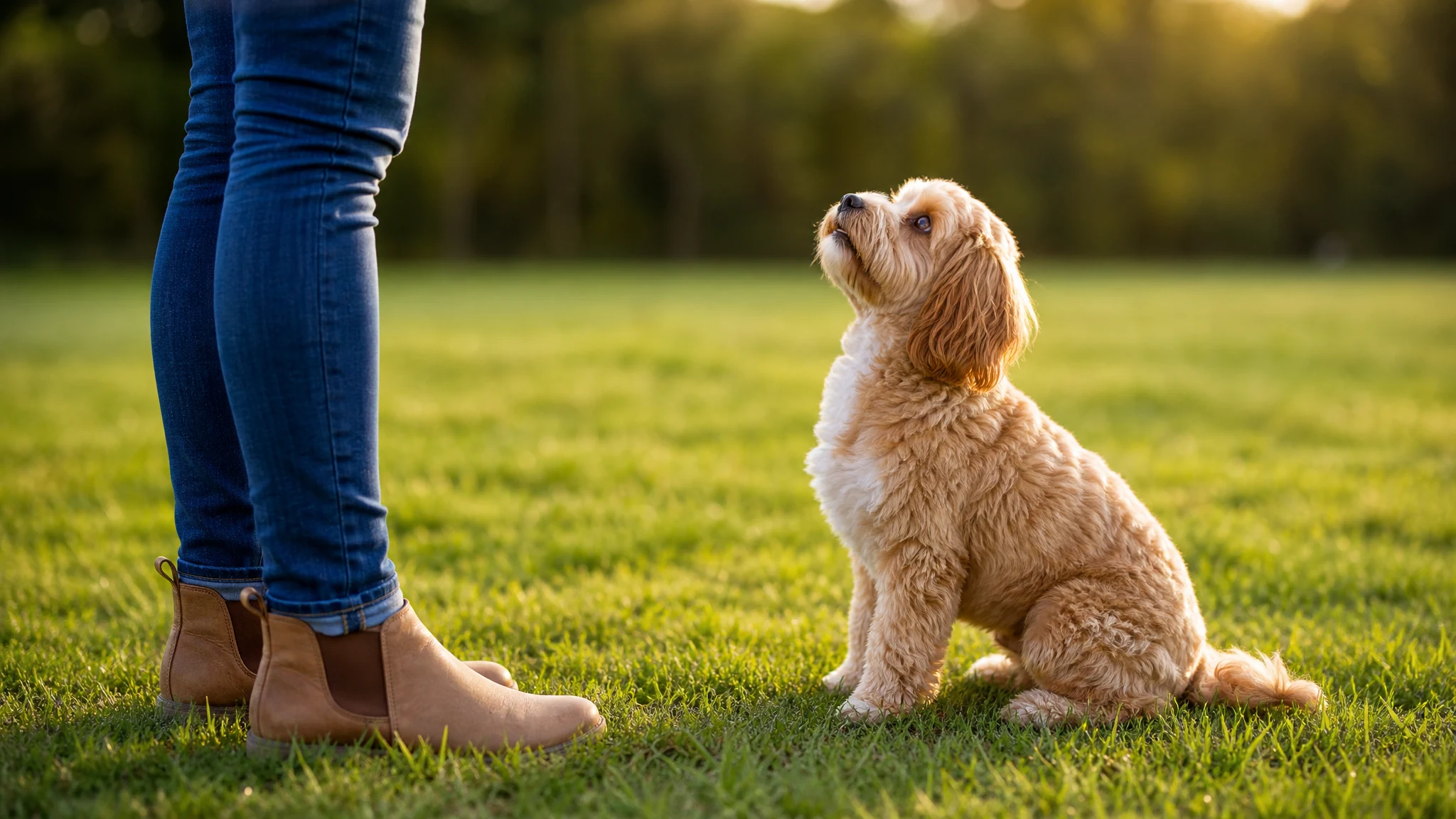
General training information. Every dog is an individual; for health or behavior concerns, see your veterinarian.
Cavapoo training is a pleasure for most owners. This crossbreed combines a Poodle's brains with a Cavalier King Charles Spaniel's wish to please. It also comes with a few predictable trouble spots, and knowing them early saves a lot of frustration.
This guide covers how to train a Cavapoo from the first week home through adulthood. It explains where the breed comes from and why that matters, which rewards work, how much exercise and brain work to plan for, and what to watch for. Every dog is an individual, so treat the breed notes as a starting point and not a promise.
Key Takeaways
- The Cavapoo is a companion crossbreed. Healthy Paws Pet Insurance describes it as very trainable with positive reinforcement.
- Both parent breeds contribute: the Poodle adds intelligence, and the Cavalier adds eagerness to please.
- Keep sessions short, repeat them often, and reward good choices. Humane, reward-based methods are the only approach this site recommends.
- Exercise needs are moderate. Petful says to avoid forced running or long hikes while a puppy's joints are developing.
- Plan ahead for separation anxiety, coat matting, weight gain from treats, and the fact that there is no breed standard.
- Health concerns belong with your veterinarian, not with a training plan.
Table of Contents
- What the Cavapoo Was Bred For and Why It Shapes Training
- Cavapoo Training Stages: Puppy to Adult
- Motivation That Works for This Breed
- Exercise and Mental Work
- Challenges to Plan For
- Health, Breeders and Your Training Plan
- Putting a Cavapoo Training Routine Together
What the Cavapoo Was Bred For and Why It Shapes Training
The Cavapoo is a designer cross between a Cavalier King Charles Spaniel and a Poodle, usually a Toy or Miniature Poodle. Elanco's My Pet and I breed profile notes that no official breed name or standard exists. In Australia the same cross is called a Cavoodle.
The origin story depends on who you ask. Greencross Vets says the cross is believed to date from the 1950s, likely from an accidental mating, and also points to the first officially recorded litter in Australia in the 1990s. Treat the history as loosely documented and not settled.
A companion by design
According to Healthy Paws Pet Insurance, the Cavapoo was bred as a companion dog. The idea was to combine the Poodle's low-shedding, low-allergy coat and intelligence with the Cavalier's gentle companion temperament.
That purpose is the key to training this dog. A companion is built to be near people and to care what they think. Your Cavapoo is not likely to be a dog that works independently in a field. It is more likely to want to be with you, and that closeness is both your best training tool and the source of its biggest challenge.
What each parent contributes
Wikipedia describes the Poodle as originally a water retriever for waterfowl hunters, and the Cavalier King Charles Spaniel as a companion lap dog. Healthy Paws and Petful both credit the Poodle side with intelligence and the Cavalier side with eagerness to please.
Purina Australia describes the Cavoodle temperament as friendly, affectionate, sociable and playful, and generally good with children and other pets. Healthy Paws adds that very small children should be supervised around the dog.
Individual dogs vary. One Cavapoo may be a bundle of energy, while a littermate lounges. Greencross says Cavoodles can be alert watchdogs that may bark at strangers, while Healthy Paws rates barking as low. Both can be true of different dogs, so watch the dog in front of you.
What this means for you
- A dog that wants to please learns fast when you are clear and consistent.
- A dog bred for company struggles when left alone, so independence needs deliberate practice.
- A smart dog gets bored. Boredom shows up as chewing and mischief.
- A friendly dog still needs socialization to stay relaxed around new people and animals.
Cavapoo Training Stages: Puppy to Adult
Petful says Cavapoos reach adult size at around 9 to 12 months. Healthy Paws gives an adult weight range of 9 to 25 pounds, depending largely on whether the Poodle parent was a Toy or a Miniature, and a height of 9 to 14 inches. Training should match where your dog is in that growth, not just its age on paper.
The stages below are a practical framework, not a fixed calendar. Move on when your dog is ready.
Stage 1: The first weeks at home
Your goals are routine, safety and trust. Set up a predictable rhythm for meals, potty trips, play and sleep. Healthy Paws notes that the breed responds well to repetition and routine, so give it both from day one.
- Potty training: Take your puppy out after waking, eating and play, and reward right after it finishes outside. Do not punish accidents. Clean them up and move on.
- Name and attention: Say the name, and reward every time your puppy looks at you.
- Handling: Gently touch paws, ears, mouth and coat while giving treats. This prepares the dog for grooming, which this breed needs often.
- Crate or safe space: Make it a comfortable place with chews and rewards, never a place of punishment.
Stage 2: Early socialization and manners
Elanco's profile recommends early socialization, and says the breed is generally sociable with other household pets. Introduce your puppy to new people, surfaces, sounds and calm, vaccinated dogs in short, pleasant doses. Ask your veterinarian when it is safe for your puppy to meet other dogs and visit public places.
At the same time, teach the basics:
- Sit, down and come when called
- Settle on a mat
- Leave it and drop it
- Walking beside you on a loose leash
Keep each session to a few minutes. Short, frequent sessions fit a puppy's attention span, and they suit a breed that thrives on repetition.
Stage 3: Adolescence
Many dogs seem to forget their training during adolescence. Your Cavapoo may test boundaries, get distracted outdoors, or chew more. This is normal development, not a sign you did something wrong.
Go back to basics. Practice in easy places first, then add distractions slowly. Reward more often, and make sure your dog gets enough exercise and mental work. Petful notes that understimulated dogs may chew, which is a good reason to keep puzzle toys and training games in the daily mix.
Stage 4: Adult polish
Once your dog is close to full size, you can lengthen sessions and raise your standards. Work on longer stays, reliable recall in more distracting settings, and calm behavior around visitors. Healthy Paws lists obedience and agility as suitable activities for the breed, and notes the Cavalier parent also does rally. These are fun ways to keep a trained dog engaged for life.
Training never really ends. A few minutes a day of practice keeps skills sharp and keeps your bond strong.
Motivation That Works for This Breed
Petful rates the Cavapoo's trainability as high and says it responds to positive reinforcement. Healthy Paws also describes the breed as very trainable with positive reinforcement. That matches the guidance of the American Veterinary Society of Animal Behavior (AVSAB), which supports reward-based training.
This site recommends humane, reward-based methods only. Never use shock, prong or choke collars, alpha rolls, scruffing or any dominance-based method. They are unnecessary with a dog that already wants to cooperate, and they can damage trust and make behavior problems worse.
Use what your dog loves
- Food: Small, soft treats work well for quick repetition. Count them as part of the daily food allowance (see the weight section below).
- Praise and affection: A companion breed often values your voice and touch. Use warm, upbeat praise.
- Play: A short game of tug or fetch after a good response can be a strong reward.
- Life rewards: A sit before the door opens, or before the leash goes on, teaches manners all day long.
Timing and clarity
Reward the instant your dog does the right thing, so it knows exactly what earned the treat. A clicker or a short marker word such as "yes" can help. Use one cue per behavior and say it once. Repeating a cue over and over teaches your dog to wait for the third or fourth try.
Make it a game
Because the breed is smart, it can get bored with endless repetition. Mix up the order of cues, change locations, and add small challenges. Healthy Paws notes patience helps, so if your dog gets stuck, make the task easier rather than pushing harder.
Manage as well as teach
Prevention is part of training. If your puppy chews shoes, put shoes away and offer a chew toy. If it dashes through doors, use gates and leashes until the habit of waiting is built. Every time a puppy practices the wrong thing, it gets a little better at it.
Exercise and Mental Work
Exercise and training are linked. A dog with pent-up energy cannot focus, and a bored dog invents its own entertainment.
How much exercise
Greencross Vets suggests about 30 to 60 minutes daily for a Cavoodle, and Petful describes two short-to-medium walks plus play. Petful calls the Cavapoo a companion dog and not an athlete, so the need is moderate and not intense. Purina Australia rates the Cavoodle's energy as high and says it needs regular exercise and mental stimulation. Sources differ, so watch your own dog: if it is restless and destructive, it likely needs more activity, and if it is exhausted or sore, it needs less.
Protect growing joints
Petful advises puppies need short, frequent play and rest, and that forced running or long hikes should be avoided on developing joints. Keep puppy outings gentle and let your dog set the pace. Ask your veterinarian what level of activity is right for your individual dog.
Brain work counts too
Mental effort tires a smart dog out as well as a walk does. Ideas include:
- Food puzzles and snuffle mats
- Hide-and-seek with toys or treats
- Learning new tricks, such as spin, paw or fetching a named toy
- Short training sessions during walks
- Rotating toys so they stay interesting
Sports and activities
Healthy Paws lists obedience and agility for the breed, and notes that the Cavalier parent also does obedience, agility and rally per PetMD. Consider a beginner class for fun. Not every Cavapoo will want to compete, and that is fine. The goal is a happy, engaged dog.
Challenges to Plan For
Petful lists the main known challenges of the breed: separation anxiety, a coat that mats easily, weight gain from treats, and quality that varies by breeder because there is no breed standard. Each one can be managed with planning.
Separation anxiety
Petful describes separation anxiety in the breed as barking, chewing and house-soiling when left alone. Since the Cavapoo was bred for companionship, this makes sense.
Build alone-time skills gradually:
- Start with very short absences while your dog is calm, and return before it becomes upset.
- Give a long-lasting chew or food toy as you leave.
- Keep arrivals and departures low-key.
- Increase the time slowly, only as fast as your dog stays relaxed.
- Make sure it has had exercise and a potty break first.
If your dog panics, destroys things or soils the house every time you leave, talk to your veterinarian. Severe cases may need professional behavior support, and only a vet can address any medical side. Do not punish a distressed dog, as it makes anxiety worse.
Coat care as a training topic
Petful says the coat mats easily and needs frequent brushing. Healthy Paws describes very low shedding, but notes that coats vary by individual and are not guaranteed hypoallergenic. Wikipedia-style claims that the cross is allergy-proof should be treated with caution, because the Cavalier parent does not share the Poodle's low-shedding coat, so coats differ from dog to dog.
Teach your puppy to enjoy brushing early. Do a few calm strokes, reward, and stop before the dog gets fussy. Practice being handled on a table or mat, and get your dog comfortable with the dryer, clippers and nail trims in small steps. Ask a professional groomer how often your dog's coat type needs care.
Weight gain from treats
Training uses many treats, and a small dog can gain weight fast. Use tiny pieces, and take some of your dog's regular meal and use it as rewards. Mix in praise and play. Ask your veterinarian about your dog's ideal weight and daily food amount. I will not give feeding amounts here, because they depend on the individual dog.
Barking
Healthy Paws rates barking as low, but Greencross says some Cavoodles are alert watchdogs. If your dog barks at sounds or strangers, reward quiet moments, teach a "settle" on a mat, and avoid shouting, which can sound like barking along. Check that it is getting enough exercise and attention too.
Chewing
Chewing is normal in puppies and shows up more when dogs are understimulated, per Petful. Give appropriate chews, rotate toys, and puppy-proof your space. Trade rather than grab: offer a treat in exchange for a stolen item so your dog learns to bring things to you.
Prey drive and recall
Healthy Paws notes that the breed has low prey drive, which can make off-leash reliability easier than with some breeds. Still, any dog can bolt after a squirrel or a car. Build recall with great rewards, practice on a long line first, and only go off-leash in safe, legal places.
Health, Breeders and Your Training Plan
Training and health are linked. A dog in pain or ill may act out, refuse to move, or seem stubborn. Always rule out medical causes first.
Health conditions to know about
Petful lists mitral valve disease and syringomyelia (from the Cavalier side), and progressive retinal atrophy and patellar luxation (from the Poodle side). Elanco's profile lists hip dysplasia, epilepsy and luxating patellas. PetMD says mitral valve disease is the leading reported cause of death in Cavaliers. This does not mean your dog will develop these conditions. It means you should know the signs to mention to your vet and keep regular checkups.
Questions about your own dog's health, symptoms or exercise limits belong with your veterinarian. This guide cannot diagnose a dog.
What responsible breeding looks like
Because there is no Cavapoo breed standard, Petful warns that quality varies by breeder. Elanco advises screening both parents of a Cavoodle puppy for inheritable conditions. The Cavalier King Charles Spaniel Club, USA lists these health tests for Cavaliers:
- Heart clearance by a board certified veterinary cardiologist, at a minimum age of 2.5 years
- Eye screening by a veterinary ophthalmologist
- Patella evaluation
- Hip X-ray submitted to the Orthopedic Foundation for Animals (OFA)
Ask any breeder which tests both parents have had, and ask to see the results. For the Poodle parent's recommended tests, check with the Poodle Club of America. I found no Cavapoo national breed club, so there is no dedicated club to consult for the cross itself. Healthy Paws lists several non-AKC registries for crossbreeds, but registration alone does not tell you whether a puppy is healthy or well-bred.
Lifespan and long-term planning
Healthy Paws gives a life expectancy of 12 to 15 years, while Elanco and Greencross give 10 to 14 years for the Cavoodle. Treat these as ranges. Either way, you are committing to a decade or more of training, grooming and care, so plan for it.
Putting a Cavapoo Training Routine Together
Here is a simple way to turn the advice above into daily habits. Adjust it to your dog.
A sample day
| Part of the day | What to do |
|---|---|
| Morning | Potty trip, short walk, a few minutes of cue practice before breakfast |
| Midday | Puzzle toy or food game, a rest period, another potty trip |
| Afternoon | Second walk or play session, a short brushing practice |
| Evening | Settle-on-mat practice while the household is calm, a chew toy |
| Throughout | Reward good choices, practice alone-time in small steps |
Cavapoo training tips to keep in mind
- Keep sessions short and end on a success.
- Be consistent: everyone in the house uses the same cues and rules.
- Reward what you want to see more of, and manage the environment to prevent the rest.
- Socialize early, gently and at your dog's pace.
- Teach calm and independence as carefully as you teach tricks.
- Count treats toward the daily food allowance.
- Be patient. Setbacks in adolescence are normal.
When to get help
If your dog shows fear, aggression, or extreme distress when left alone, start with your veterinarian to rule out medical causes. Then look for a trainer who uses reward-based methods in line with AVSAB guidance. Ask what tools and techniques they use, and walk away from anyone who relies on shock, prong or choke collars, or dominance methods.
The bottom line
How to train a Cavapoo comes down to working with the dog's nature. It is a smart, affectionate companion that wants to be with you. Give it clear rules, plenty of rewards, moderate exercise, real mental work and slow practice at being alone, and you will have a good foundation. Results vary from dog to dog, but this approach respects both the breed and the individual.