How Much Exercise Does a Cavapoo Need? Plus Brain Games
General training information. Every dog is an individual; for health or behavior concerns, see your veterinarian.
Ask ten owners how much exercise a Cavapoo needs and you may get ten different answers. That is because the cross is a mix of a Cavalier King Charles Spaniel and a Poodle, usually a Toy or Miniature. Individual dogs vary a lot.
This guide gives you a simple plan. You will set a daily exercise target, add mental work, and adjust as your dog grows. It also covers the mistakes that tend to cause chewing and restlessness.
The Short Answer
Cavapoo exercise needs are moderate, not intense. Greencross Vets suggests about 30 to 60 minutes a day for the Cavoodle, which is the Australian name for the same cross. Petful describes the routine as two short-to-medium walks plus play.
Sources do not agree on energy level. Petful calls the Cavapoo a companion dog, not an athlete. Purina Australia rates the Cavoodle's energy as high and says it needs regular exercise and mental stimulation. So treat the range as a starting point and watch your own dog.
Greencross also notes that an understimulated dog may chew. Exercise is only half the picture. Cavapoo mental stimulation matters just as much, and the second half of this guide covers it.
What You Need
- A well-fitted flat collar or a harness, plus a standard leash (no prong, choke or shock tools)
- A long line of about 15 to 30 feet for sniffing on safe, open ground
- Small, soft treats, or part of your dog's daily meal measured out
- A puzzle feeder or a snuffle mat
- A few household items for games, such as cardboard boxes, a muffin tin and tennis balls
- A grooming brush, because active Cavapoos pick up debris and the coat mats easily
- A notebook or phone notes to track what your dog does each day
Step 1: Know Your Dog's Size and Life Stage
Healthy Paws Pet Insurance lists adult Cavapoos at 9 to 14 inches tall and 9 to 25 pounds. Petful gives 12 to 25 pounds. A Toy Poodle cross will usually be smaller and a Miniature Poodle cross larger. Smaller dogs tire sooner on long walks, so size matters when you set the plan.
Petful says the Cavapoo reaches adult size around 9 to 12 months. That gives you three rough stages to plan around.
- Puppy (under about 9 to 12 months): short, frequent play and plenty of rest.
- Adult: the moderate daily range above.
- Senior: ask your veterinarian how to adjust. The sources we rely on do not give senior exercise limits.
Step 2: Set a Daily Exercise Target
Start in the middle of the range for an adult dog. A common split looks like this:
- A morning walk of 15 to 25 minutes.
- A short play session midday, such as indoor fetch or a gentle tug game.
- An evening walk of 15 to 25 minutes.
Add up the minutes. If you land near the 30 to 60 minute range Greencross describes, you are in the right area. Then watch the dog, not the clock.
A dog that settles after the walk is probably getting enough. A dog that chews furniture, paces or barks for attention may need more activity, more mental work, or both. A dog that lags, pants hard or refuses to walk may be doing too much.
Step 3: Protect Puppy Joints
Petful advises short, frequent play and rest for puppies. It also says to avoid forced running and long hikes while joints are developing. Patellar luxation is listed among the breed's common health issues by both Petful and Elanco, which is one more reason to be gentle early on.
Here is how to apply that:
- Keep walks short and let the puppy set the pace.
- Choose several 5 to 10 minute play sessions over one long outing.
- Skip jogging, long hikes and repetitive ball chasing until your veterinarian says the joints are ready.
- Let the puppy nap. Rest is part of training.
Your veterinarian can tell you when your individual puppy can build up. The sources do not give exact minutes by month, so we will not either.
Step 4: Turn Walks Into Sniff Walks
A sniff walk lets your dog choose where to investigate. Nose work tires a dog mentally, and it suits a dog with a Poodle parent whose breed was originally a water retriever for waterfowl hunters, according to Wikipedia's Poodle entry. Using the nose is a natural job for a retrieving breed, though your individual dog may differ.
To try it:
- Pick a quiet, safe route. A grassy edge or a park path works well.
- Clip on the long line, or use a loose standard leash.
- Stop when your dog stops. Let them sniff for as long as they like, within reason.
- Move on with a happy voice and a treat if they follow you easily.
Ten minutes of sniffing can feel like more work to a dog than a faster, longer march. Many owners find their dogs settle more afterward, although results differ.
Step 5: Add Puzzle Feeders
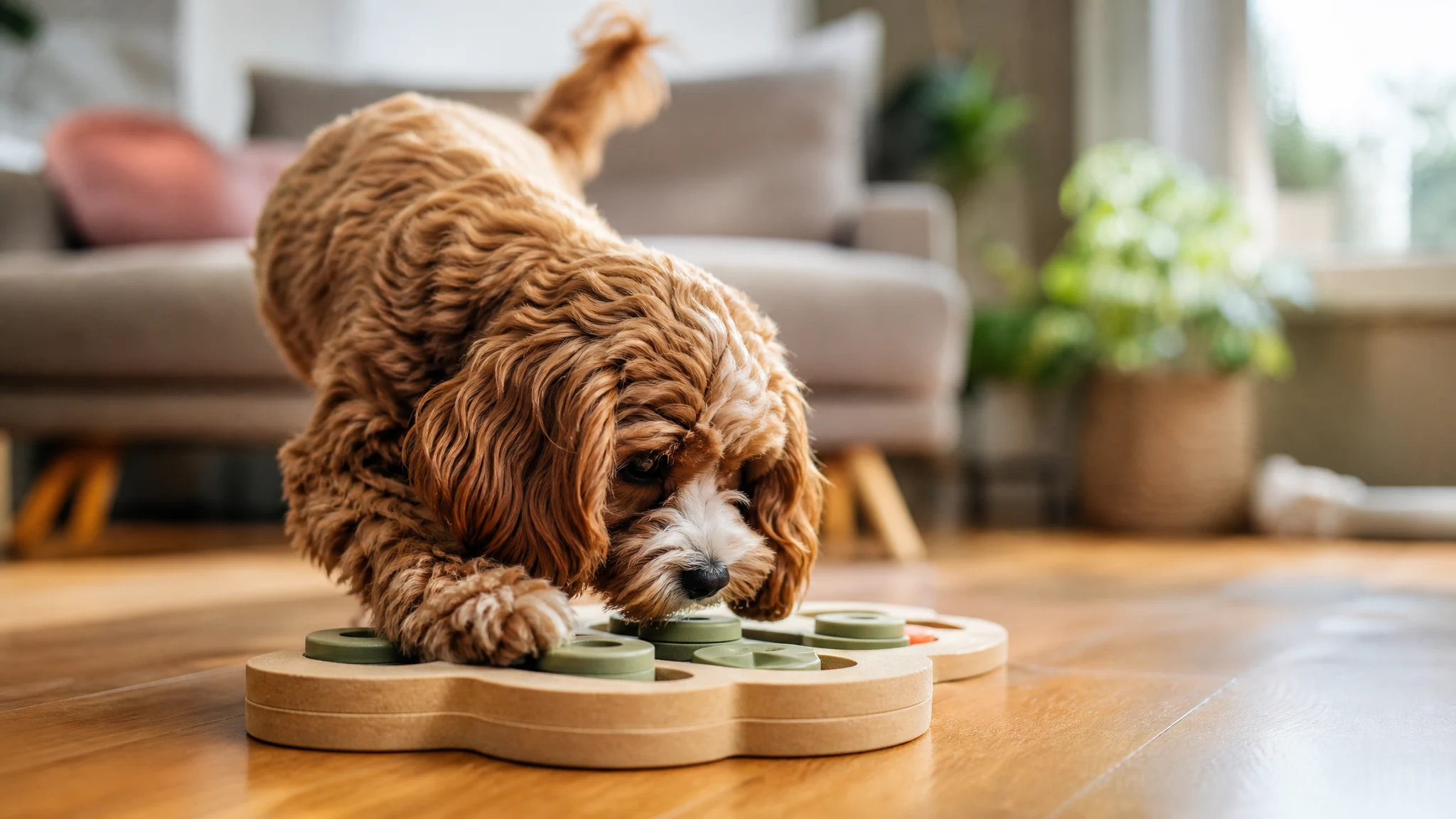
Cavapoo mental stimulation does not need to be fancy. A puzzle feeder or snuffle mat turns a meal into a task.
- Start with an easy puzzle so your dog wins quickly.
- Use part of the daily meal, not extra food. Petful lists weight gain from treats as a challenge for the breed.
- Stay nearby the first few times in case your dog gets frustrated or tries to chew the toy.
- Raise the difficulty slowly, only once the dog solves the current level easily.
Puzzle feeders are especially handy on rainy days or when you cannot get out for a full walk.
Step 6: Play Training Games
Petful rates trainability as high, and Healthy Paws describes the breed as smart and responsive to repetition and routine. The Poodle parent adds intelligence and the Cavalier parent adds eagerness to please. Short training games put both traits to work. All of them use rewards only.
Find It
Show your dog a treat, then drop a few treats in the grass or on the floor and say "find it." Later, hide treats around a room. This uses the nose and builds focus.
Muffin Tin Shuffle
Put a treat in a few cups of a muffin tin and cover each cup with a tennis ball. Your dog works out how to remove the balls. Supervise so no one swallows a ball or chews it up.
Fetch and Bring Back
The Poodle was a water retriever and the Cavalier a lap dog, so fetch may come naturally to some Cavapoos and not at all to others. Keep it light. Reward any return to you, even with the toy dropped at your feet.
Three-Trick Rotation
Pick three cues, such as sit, down and touch. Ask for each one, reward, and swap cues every few repetitions. Keep sessions to about five minutes. For a full foundation of cues and routines, see our complete guide to training a Cavapoo.
Dog Sports as a Next Step
Healthy Paws lists obedience and agility as options for the breed in a companion role, and PetMD lists rally for the Cavalier parent. If your dog loves training games, a beginner class can be a fun way to keep both of you busy. Ask your veterinarian first, especially for jumping work.
Step 7: Build a Weekly Rhythm
Variety keeps the brain engaged. Here is one sample week for an adult dog. Adjust it to your dog's size and energy.
| Day | Movement | Brain work |
|---|---|---|
| Monday | Two moderate walks | Puzzle feeder at dinner |
| Tuesday | Sniff walk plus short play | Find it indoors |
| Wednesday | Two moderate walks | Three-trick rotation |
| Thursday | Sniff walk on a long line | Snuffle mat |
| Friday | Two moderate walks | Muffin tin game |
| Saturday | New route or park visit | Short training session in a new place |
| Sunday | Easy walk and play | Rest and a simple chew |
Tips for Better Results
- Split the day. Two or three shorter outings often suit this breed better than one long one.
- Socialize early. Elanco recommends early socialization, and says the breed is generally sociable with other household pets.
- Watch around small children. Healthy Paws says Cavapoos are generally good with children, but very small children should be supervised during play.
- Practice being alone. Petful lists separation anxiety as a challenge, with barking, chewing and house-soiling when left alone. Give your dog a puzzle toy and a calm exit, and build alone time slowly.
- Brush after outdoor play. Petful notes the coat mats easily and needs frequent brushing.
- Use part of the meal for rewards. This helps with the weight gain that treats can cause.
Common Mistakes to Avoid
- Over-exercising a puppy. Long hikes and forced running are not advised while joints develop.
- Relying on physical exercise alone. A tired body does not always mean a settled mind. Add sniffing and puzzles.
- Making games too hard too fast. A frustrated dog may quit or chew the toy. Keep early wins easy.
- Assuming every Cavapoo is the same. There is no official breed standard, so energy and size vary. Compare your dog to their own habits, not to a number.
- Using harsh corrections. The American Veterinary Society of Animal Behavior supports reward-based methods. Skip shock, prong and choke tools, alpha rolls and scruffing. They can damage trust and are not needed for this eager-to-please cross.
- Ignoring signs of tiring. Heavy panting, lagging or lying down on a walk means it is time to stop and rest.
A Note on Health and Exercise
The Cavalier parent is prone to mitral valve disease, which Petful lists as a breed health concern. Petful and Elanco also list conditions such as patellar luxation, hip dysplasia and progressive retinal atrophy. The Cavalier King Charles Spaniel Club, USA advises heart, eye, patella and hip screening for Cavalier breeding stock. Elanco advises screening both parents of a Cavoodle puppy.
If your dog coughs, tires unusually fast, limps or seems to struggle with exercise, call your veterinarian. This article cannot tell you what is wrong, and it cannot set limits for a dog with a health issue.
What to Expect
With a steady routine, many owners find their Cavapoo is calmer at home and less likely to chew out of boredom. A mix of walks, sniffing and short training games may also help your dog focus better during training. Results depend on age, health, temperament and consistency, so give it a few weeks before you judge.
If your dog still seems restless after a few weeks, add more variety before you add more minutes. If problems like destructive chewing or distress when alone continue, talk to your veterinarian or a qualified reward-based trainer.
Quick Recap
- Know your dog's size and life stage.
- Set a moderate daily target and watch how your dog responds.
- Protect puppy joints with short, frequent play and rest.
- Swap some walks for sniff walks.
- Feed with puzzle toys.
- Play short, rewarding training games.
- Mix up the week and check in with your veterinarian about health.